How to Read a Balance Sheet: A Step-by-Step Guide
Your company's financial "photo" at a single moment in time.
Introduction: The Financial Snapshot
Imagine taking a photograph of everything you own and everything you owe right now. That is exactly what a balance sheet is for a business. While the income statement tells you how the business performed over a year, the balance sheet tells you its position at the end of that year.
It is the Intelligent tool for assessing risk. If a company has a lot of "performance" (revenue) but no "position" (assets/liquidity), it is like a fast car with a tiny fuel tank—eventually, it will stall.
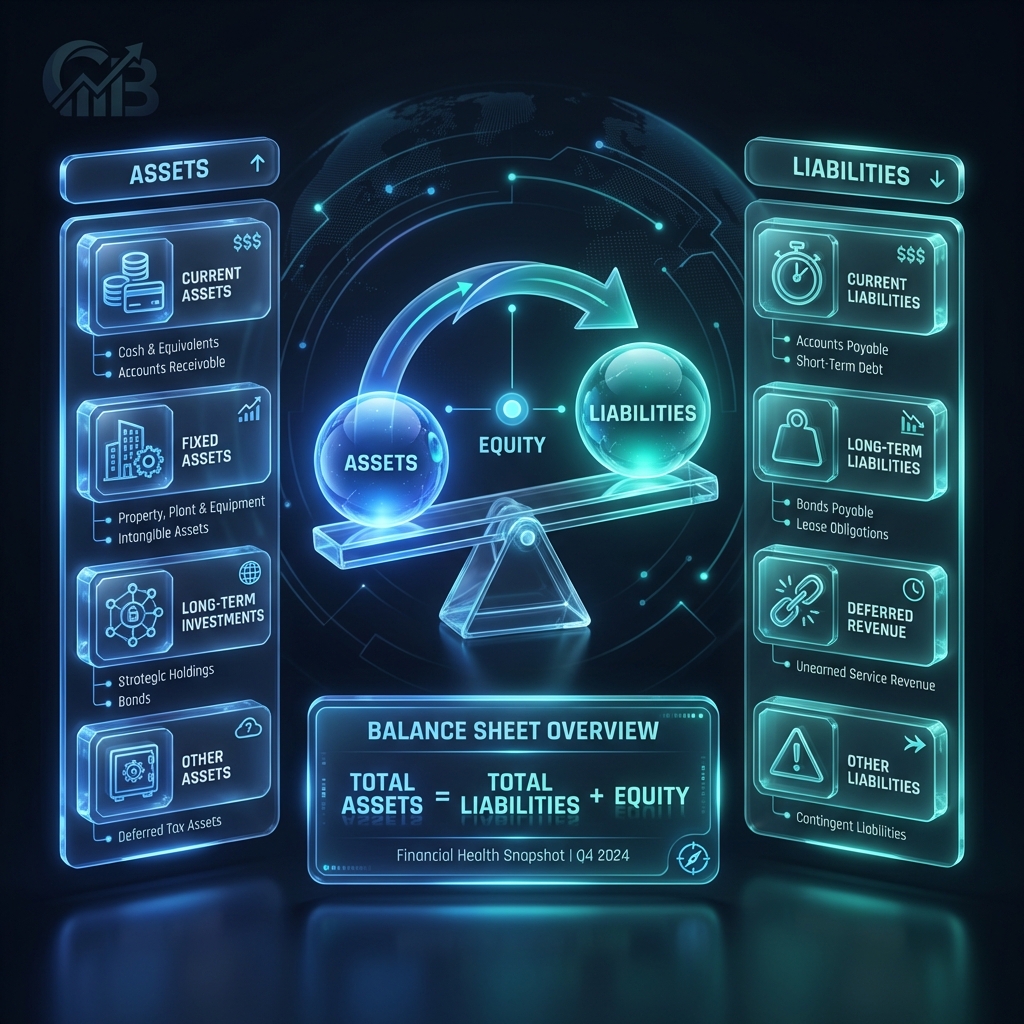
The Balancing Act
Everything a company owns (Assets) must be balanced by either borrowed money (Liabilities) or owner investment (Equity).
Anatomy of a Balance Sheet: Beyond the Basics
To truly master the balance sheet, you need to look beyond the simple headers. Here are the GAAP (Generally Accepted Accounting Principles) terms that professional analysts scrutinize:
1. Assets (What You Own)
- Current Assets: Cash, Marketable Securities, and Accounts Receivable (money owed to you by customers).
- Inventory: The raw materials and finished goods waiting to be sold.
- Goodwill & Intangibles: This often confuses beginners. Goodwill represents the premium a company paid when buying another business above its "fair value." High goodwill can be a risk if the acquisition fails to perform.
2. Liabilities (What You Owe)
- Accounts Payable: Money you owe to suppliers.
- Deferred Revenue (Unearned Revenue): This is a "good" liability. It represents money customers paid in advance for services you haven't delivered yet (like a SaaS subscription).
- Accrued Expenses: Liabilities that have been built up but not yet invoiced, like employee wages or taxes.
3. Shareholders' Equity (The Net Worth)
- Retained Earnings: This is the "soul" of the company. It is the cumulative total of all profits kept by the business since its inception.
- Treasury Stock: Shares the company has bought back from the market. This reduces equity but can increase the value of remaining shares.
🚩 7 Critical Balance Sheet Red Flags
If you spot these trends while checking a stock, proceed with extreme caution:
- 1. Accounts Receivable Growing Faster than Revenue: This means the company is logging sales but failing to actually collect the cash from customers.
- 2. Ballooning Goodwill: If 50% or more of the assets are "Goodwill," the company may be overpaying for acquisitions to hide a lack of organic growth.
- 3. The "Death Spiral" of Retained Earnings: If retained earnings are consistently negative (Accumulated Deficit), the company is burning through its capital to survive.
- 4. Shrinking Shareholders' Equity: If liabilities are growing so fast that equity is disappearing, the company is approaching insolvency.
- 5. Spiking Short-term Debt: Relying on short-term loans to fund long-term operations is a recipe for a liquidity crisis.
- 6. Declining Cash relative to Debt: If "Cash & Equivalents" is dropping while "Total Debt" is rising, the "buffer" is disappearing.
- 7. Frequent "Asset Write-Downs": This is an admission by management that the assets they listed previously are actually worth much less.
How to Analyze a Balance Sheet Like a Pro
- Calculate Working Capital: Subtract Current Liabilities from Current Assets. This is the company's "breathing room." If it's negative, they might need to issue more shares or take on debt just to pay the bills.
- Check the Tangible Book Value: Subtract "Goodwill & Intangibles" from Total Equity. This tells you what the company is worth if you only count physical, touchable assets.
- Look for "Off-Balance Sheet" Leases: Under modern GAAP, most leases are now on the balance sheet, but always check the footnotes for hidden obligations.
Essential Solvency Metrics
Current Ratio
Formula: Current Assets / Current Liabilities.
Goal: Above 1.5. Below 1.0 means the company may struggle to pay immediate debts.
Debt-to-Equity
Formula: Total Liabilities / Total Equity.
Goal: Varies by industry, but look for trends. A rising ratio means higher financial risk.
Quick Ratio (Acid Test)
Formula: (Cash + Receivables) / Current Liabilities.
Goal: A stricter version of the Current Ratio that excludes inventory.
Intelligent Investor Checklist: Balance Sheet Edition
- ✅ Is the Current Ratio healthy (above 1.0)?
- ✅ Is "Tangible Book Value" (Equity minus Intangibles) positive?
- ✅ Are "Cash & Equivalents" sufficient to cover short-term debt?
- ✅ Is "Goodwill" less than 20% of total assets (avoiding acquisition bloat)?
- ✅ Is Shareholders' Equity growing over the long term (5-10 years)?