In-depth Apple company analysis covering business model, services margins, financial strength, competitive moat, risks, and intrinsic value scenarios.
Introduction: Apple Is More Than a Product Company
When most people think of Apple, they think of the iPhone. But understanding Apple Inc. properly requires stepping back. Apple is not simply a smartphone manufacturer. It is an ecosystem company — a global platform built around devices, software, services, and deeply embedded customer relationships.
Today, Apple operates with:
More than 2.5 billion active devices
A blended gross margin of roughly 48%
A Services segment generating approximately 76% gross margin
Substantial recurring free cash flow
A balance sheet designed for resilience
The real story of Apple is not just about product launches. It is about economic structure — how the company generates durable profits from a tightly integrated ecosystem.
This article is intended solely for informational purposes. None of the content presented here constitutes investment advice or a recommendation. Please consult a qualified financial advisor and do your own due diligence before making any investment decisions.
This article explains Apple's business model, competitive advantages, financial structure, long-term strategic positioning, risks and macro exposure, and a structured intrinsic value framework using scenario analysis. For investors wondering is apple a good stock to buy, understanding these fundamentals is essential. You can also dive deep into Apple's key financial metrics or explore our free investing tools to analyze stocks like Apple in depth.
1. Company Overview: What Apple Actually Does
Apple designs, manufactures, and sells premium consumer technology products while monetizing a global software and services platform. Its operations fall into two broad segments:
Hardware
iPhone
Mac
iPad
Apple Watch
AirPods
Accessories
Services
App Store
Apple Music
iCloud
Apple TV+
Apple Pay
AppleCare
Other digital subscription services
The hardware introduces users into the ecosystem. The services deepen monetization over time.
Think of Apple not as a product company — but as a digital environment provider. Once customers enter the ecosystem, leaving becomes inconvenient. That friction creates economic durability.
2. The Apple Business Model: Ecosystem Economics in Action
Apple's model works in layers, creating a self-reinforcing cycle that drives both revenue growth and customer retention.
Layer 1: Premium Hardware
Apple competes in the high-end segment. It does not attempt to dominate unit share across all price tiers. Instead, it focuses on:
Design quality
Performance
Integration
Brand trust
User experience
The iPhone remains the anchor product. It drives ecosystem participation and is central to understanding apple stock prediction models.
Layer 2: Services Expansion
The Services segment is economically transformative. With gross margins around 76%, services contribute disproportionately to profitability.
Why services matter:
Recurring revenue
Low incremental cost
High margin stability
Deep ecosystem integration
As the installed base grows, services monetization scales. This is a key factor when analysts evaluate apple stock price prediction 2030.
Layer 3: Installed Base Compounding
With over 2.5 billion active devices, Apple has created an enormous platform. Each device represents:
A recurring revenue opportunity
A future upgrade cycle
A subscription customer
A cross-sell participant
The ecosystem becomes self-reinforcing, creating powerful network effects that strengthen Apple's competitive position.
3. Core Revenue Drivers Explained
iPhone: The Economic Engine
The iPhone drives:
Revenue scale
App Store economics
Upgrade cycles
Accessory demand
Services usage
Even in a mature global smartphone market, Apple has maintained pricing power in the premium category. Understanding iPhone dynamics is crucial for anyone researching how to analyze a stock like Apple.
The growth of services enhances business stability and is a primary driver of long-term value creation.
Wearables and Accessories
Apple Watch and AirPods:
Increase ecosystem stickiness
Raise switching costs
Improve customer lifetime value
These products reinforce platform depth and create additional revenue streams that complement the core iPhone business.
4. Apple's Competitive Advantages (Economic Moat)
Apple's moat is multi-dimensional, creating barriers that protect its market position and profitability.
1. Ecosystem Lock-In
Switching away from Apple means:
Replacing devices
Losing ecosystem integration
Migrating cloud storage
Reconfiguring apps
Switching costs are real and behavioral, creating powerful customer retention.
2. Brand Power
Apple's brand supports:
Premium pricing
Customer loyalty
Global recognition
Brand strength is an intangible asset that reinforces margins and enables pricing power that competitors cannot match.
3. Vertical Integration
Apple controls:
Hardware design
Operating systems
Custom silicon (Apple chips)
Software stack
Retail distribution
Vertical integration allows:
Performance optimization
Cost control
Cohesive user experience
4. Scale and Supply Chain Expertise
Apple operates one of the most advanced global supply chains in technology. Scale creates:
Purchasing power
Manufacturing leverage
Risk diversification
5. Financial Structure and Performance
According to Apple's Q1 2026 earnings report, the company continues to demonstrate strong financial performance across all segments.
Gross Margin Structure
Blended gross margin: ~48%
Services gross margin: ~76%
This mix supports durable profitability and provides cushion during economic downturns.
Free Cash Flow
Apple generates substantial free cash flow. Free cash flow is critical because it:
Funds R&D
Supports ecosystem expansion
Strengthens balance sheet flexibility
Balance Sheet Strength
Apple maintains:
Significant liquidity
Strong cash reserves
Manageable capital structure
This allows strategic flexibility during economic downturns and enables opportunistic capital allocation.
6. Management and Strategic Direction
Apple's strategy emphasizes:
Long-term ecosystem depth
Product excellence
Incremental innovation
Margin sustainability
Strategic priorities include:
Expanding services revenue
Investing in AI integration
Advancing custom silicon
Enhancing cross-device functionality
The approach is evolutionary rather than reckless, focusing on sustainable competitive advantages.
7. Industry Positioning and Competitive Landscape
Apple competes across:
Smartphones
Personal computing
Wearables
Streaming
Cloud services
Digital payments
Competitive pressures include:
Android manufacturers
Cloud platform rivals
Streaming competitors
Regulatory scrutiny over platform economics
Apple differentiates through:
Integration
Privacy positioning
Premium branding
Ecosystem consistency
8. Berkshire Hathaway's Apple Investment: A Notable Endorsement
One of the most significant endorsements of Apple's business model came from Warren Buffett's Berkshire Hathaway, which built a massive position in Apple stock. However, the recent berkshire hathaway apple stock sale has raised questions among investors about Apple's valuation and future prospects.
While Berkshire has reduced its position, this appears to be driven more by portfolio management and valuation considerations rather than fundamental concerns about Apple's business model. The partial sale doesn't diminish the strength of Apple's competitive advantages or long-term growth potential.
9. Intrinsic Value Framework (Educational Scenario Modeling)
Now let's introduce structured valuation thinking. This section is educational only. It reflects one discounted cash flow methodology and is not financial advice.
Intrinsic value modeling estimates the present value of future cash flows. Small changes in assumptions produce large changes in outcomes. For those interested in DCF valuation methodology, this framework provides a practical example.
For modeling illustration: Assume current annual free cash flow around $100B (rounded framework input for scenario mechanics).
This scenario assumes stability but limited acceleration. Investors concerned about why is apple stock down may find this conservative case relevant during market volatility.
Scenario 2: Base Case
Assumptions:
Free cash flow growth: 5%
Discount rate: 8%
Terminal growth: 2.5%
This assumes:
Continued services expansion
Installed base monetization
Stable gross margins
Illustrative Outcome:
Estimated equity value range: $2.4T – $2.8T Per-share equivalent: ~$150–$175
This reflects balanced ecosystem durability and represents a reasonable middle-ground scenario for apple stock prediction models.
Scenario 3: Ecosystem Acceleration Case
Assumptions:
Free cash flow growth: 7%
Discount rate: 8%
Terminal growth: 3%
This assumes:
Strong AI monetization
Increased services penetration
Sustained pricing power
Illustrative Outcome:
Estimated equity value range: $3.0T – $3.5T Per-share equivalent: ~$190–$220
This scenario reflects enhanced monetization leverage and could inform optimistic apple stock price prediction 2030 estimates.
Sensitivity Awareness
If:
Discount rate rises from 8% to 10% → valuation can drop 15–25%
Terminal growth drops by 1% → value meaningfully declines
Intrinsic value is best viewed as a range — not a single number. This uncertainty is important context when evaluating whether is apple a good stock to buy at current prices.
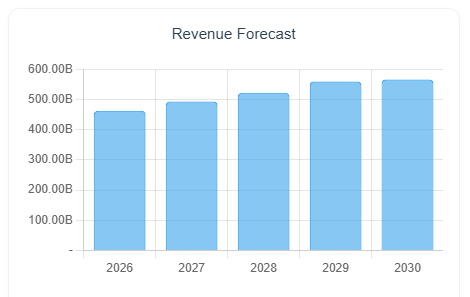
Apple 5-Year Revenue Forecast
For a detailed look at Apple's projected financial performance, explore our Apple 5-year forecasts and projections, which provide comprehensive revenue, earnings, and EPS estimates.
10. Key Risks and Structural Challenges
Even strong businesses face risks that investors must consider.
Smartphone Market Saturation
Global smartphone penetration is high. Growth depends on upgrade cycles, which can be unpredictable and are lengthening in mature markets.
Regulatory Scrutiny
App Store policies face increasing regulatory review, potentially affecting margins. Antitrust concerns in multiple jurisdictions could force changes to Apple's business model.
Supply Chain Exposure
Global manufacturing concentration introduces geopolitical risk. Trade tensions and supply chain disruptions can impact production and costs.
Innovation Pressure
Technology evolves rapidly. AI integration and product differentiation remain essential to maintaining competitive advantages and justifying premium pricing.
11. Long-Term Sustainability
Apple's sustainability rests on:
Ecosystem depth
Services margin durability
Installed base growth
Cash flow strength
Strategic discipline
With 2.5B+ devices active, recurring monetization opportunities remain substantial. The company's focus on privacy, sustainability, and user experience creates additional differentiation.
12. Macro Context and Market Dynamics
Apple operates within:
Interest rate environments
Consumer spending cycles
Currency fluctuations
Trade policies
Strong cash flow and liquidity provide economic cushioning during downturns. However, as a consumer-facing technology company, Apple remains sensitive to macroeconomic conditions.
13. Final Perspective: Understanding Apple Beyond the Headlines
Apple is a mature, globally dominant ecosystem company built on:
Vertical integration
Brand strength
Services monetization
Installed base compounding
Financial discipline
Intrinsic value modeling provides structured ways to think about long-term economics. But it is assumption-driven.
The valuation scenarios presented here:
Reflect one analytical framework
Depend heavily on growth and discount assumptions
Should be independently verified
Are not investment recommendations
For investors evaluating is apple a good stock to buy, the answer depends on individual circumstances, risk tolerance, time horizon, and valuation perspective. Understanding the business fundamentals outlined in this analysis provides a foundation for informed decision-making.
Every reader should conduct independent research and due diligence. Valuation is not certainty. It is structured judgment under uncertainty.
More Company Deep Dives
Our Company Deep Dives series applies the same analytical framework to the world's most important companies:
This article is intended solely for informational purposes. None of the content presented here constitutes investment advice or a recommendation. Please consult a qualified financial advisor and do your own due diligence before making any investment decisions.